
Description
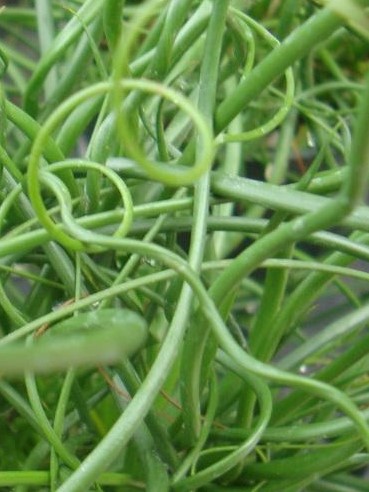
Corkscrew rush (Juncus effusus spiralis) is a distinctive evergreen marginal plant valued for its striking, spirally curled stems. This non-native member of the Juncaceae family forms compact clumps of twisted, leafless stems that provide strong architectural interest throughout the year.
In summer, corkscrew rush may produce small, inconspicuous clusters of brown flowers, though it is primarily grown for its unusual foliage rather than its blooms. With an ultimate height and spread of 0.1-0.5 metres, it is well suited to pond margins, bog gardens, containers, and contemporary planting schemes.
How to Identify
Corkscrew rush forms dense clumps of upright, corkscrew-shaped stems that twist irregularly. The stems are smooth, cylindrical and glossy green, remaining evergreen through winter.
The flowers appear in summer as small brown clusters emerging from the side of the stem rather than the tip, a typical feature of rushes.
How to Grow
Juncus effusus thrives in poorly drained or permanently moist soils, including clay, sandy, and acidic soils. Although it has a slow growth rate, it grows well in full sun or partial shade and can also be planted in very shallow water at pond or pool margins. The planting depth depends on the variety.
This hardy perennial is suitable for most UK gardens, tolerating even severe winters. It is low maintenance once established, requiring only the removal of dead foliage and old flower stems in spring. Propagation is best carried out by division from mid-spring to early summer.