
Common Ivy

1.5L Pot, 9cm Pot

Common Ivy (Hedera helix) A important wildlife plant, providing food, shelter and nest sites for many birds, insects and small mammals

Step 1: Select Product Option
Step 2: Enter Quantity
Total: £ 0.00 inc. VAT

Latin Name: Hedera helix

Common Name(s): Common Ivy, English Ivy

Plant Type: Climber, Perennial

Friendly For: Bees, Birds, RHS Plants For Pollinators

Habitat: All Soils, Full Shade, Part Shade, Sun

Colour:

Green

Height:

20-30m

Flowering Time:

September - November

SKU: NS-MAIN-3758 Category:

Description

Hedera helix is an evergreen climbing plant, growing to 20-30 m high where suitable surfaces (trees, cliffs, walls) are available, and also growing as ground cover where no vertical surfaces occur. The flowers are produced from late summer to late autumn, in small, individually arranged umbels, with a greenish-yellow hue and rich in nectar, making them an important late autumn food source for bees and other insects. The fruit is purple-black to orange-yellow ivy berries, ripening in late winter, and are an important food for many birds, though somewhat poisonous to humans.
Position in full sun or partial shade for best results.

Common ivy (Hedera helix), also known as English ivy, is a native, evergreen climber found throughout the UK in woodlands, hedgerows, towns, and gardens. It is a self-clinging evergreen climber that can grow up to 20-30 metres, using aerial roots along its climbing stems to attach to trees, walls, and fences, or spread as ground cover where no vertical support is available. Ivy flowers from late summer to autumn, followed by black berries that ripen in winter and provide an essential food source for birds.

Ivy is a valuable wildlife plant, supporting a wide range of pollinating insects with late-season nectar and providing winter berries for birds. Dense growth also offers year-round shelter and nesting opportunities.

Despite common myths, ivy is not a parasitic plant and does not harm healthy trees, despite being considered an invasive species.

How to identify

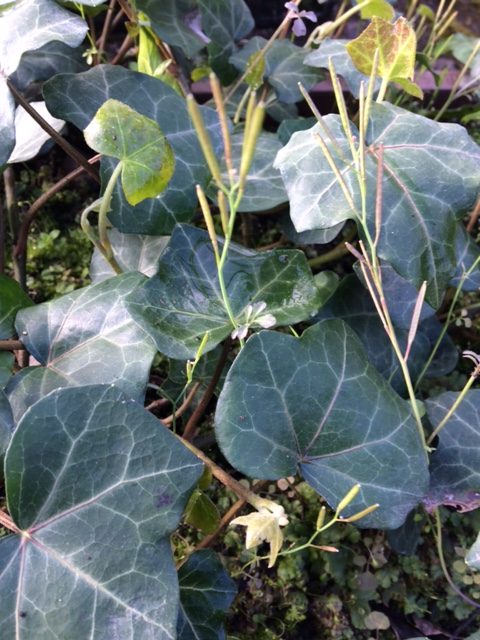
Ivy has glossy, evergreen leaves with pale veins. In its juvenile stage, leaves are typically lobed, while mature flowering shoots have oval, unlobed leaves. Small greenish-yellow flowers appear in rounded clusters, followed by black, berry-like fruits. Ivy clings using fine root hairs, not true roots.
Not to be confused with poison ivy (Toxicodendron radicans), which does not grow naturally in the UK.

How to grow

Hedera helix grows well in full sun or partial shade and tolerates most soils under typical UK growing conditions, avoiding only very dry or waterlogged ground. It is low-maintenance, easily pruned, and suitable for walls, fences, trees, or as dense ground cover in a wildlife garden.

Atlantic ivy (Hedera hibernica) is closely related and more common in western Britain; some forms can be vigorous and should be managed to prevent excessive spread.

Additional information

Option

,

Plant Type

,

Colour

Friendly For

, ,

Habitat

, , ,